Prepare for the upcoming Yellow Dust and fine dust season in South Korea with this expert survival guide. Learn about KF94 mask standards, essential air quality apps like MiseMise, and how to navigate the hazy spring months in Seoul like a local.
Yellow Dust Season is Coming: Essential Apps & Mask Guide for Expats
By Michael Choi – Local Insider, Seoul
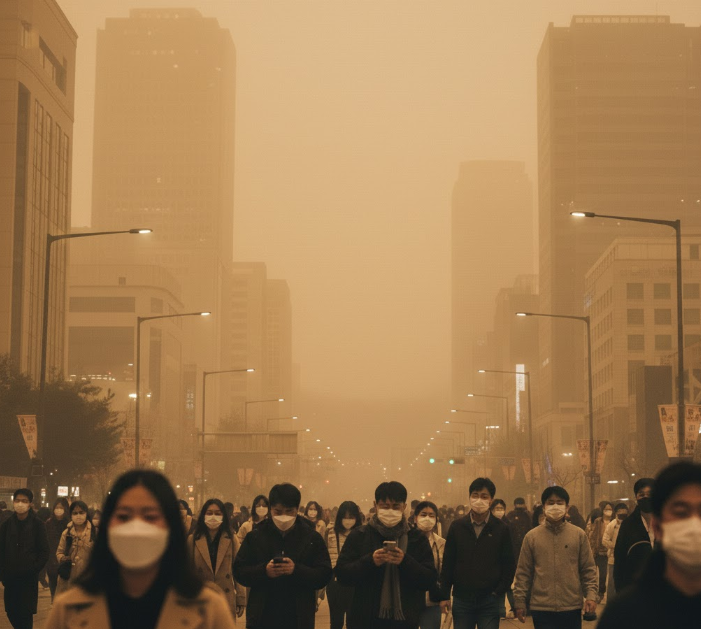
If you've recently moved to Korea, you might be enjoying the crisp winter air and the occasional snow. But as we transition into March, a different phenomenon takes over the peninsula. You'll notice the sky turning a hazy, melancholic gray-yellow. This isn't just "fog"—it's the arrival of Hwang-sa (황사), or Yellow Dust, coupled with high levels of fine particulate matter (PM2.5).
For many expats, the first sight of a yellow horizon can be alarming. Back home, a hazy sky might mean a storm is coming, but in Korea, it signals a time to change your daily habits. As someone who has lived through many Seoul springs, I’m here to tell you that while it’s a nuisance, it’s completely manageable if you have the right tools and knowledge.
1. Understanding the Enemy: Yellow Dust vs. Fine Dust
It’s important to distinguish between the two types of air quality issues we face in Korea. While they often occur together, their origins are quite different:
- Yellow Dust (Hwang-sa): This is natural desert sand from the Gobi Desert in Mongolia and Northern China. Strong spring winds carry these particles across the sea to Korea. It’s "coarse" dust but carries heavy metals and pollutants picked up along industrial zones in China.
- Fine Dust (Mise-monji): This is subdivided into PM10 (Fine Dust) and PM2.5 (Ultrafine Dust). While some comes from overseas, a significant portion is generated locally by vehicles, power plants, and construction. PM2.5 is particularly dangerous because it is small enough to enter your bloodstream directly through the lungs.
2. Decoding the Mask: Why KF94 is the Gold Standard
In Korea, you will see people wearing masks with specific codes. Unlike the simple surgical masks used elsewhere, Korea uses the "KF" (Korea Filter) rating system regulated by the Ministry of Food and Drug Safety.
| Rating | Filtration Efficiency | Best Use Case |
|---|---|---|
| KF80 | Filters 80% of average 0.6μm particles | Yellow Dust days, easier breathing. |
| KF94 | Filters 94% of average 0.4μm particles | The "Gold Standard" for high PM2.5 days. |
| KF99 | Filters 99% of average 0.4μm particles | Medical grade/extreme pollution (hard to breathe). |
| Dental/Cloth | Negligible for fine dust | Only useful for preventing droplets, not dust. |
If the Air Quality Index (AQI) hits the "Bad" (나쁨) level, you should reach for a KF94 mask. These are designed to fit tightly around the face, creating a seal that forces air through the filter. You can find these at any 7-Eleven, CU, or Olive Young for about 1,000 to 1,500 KRW each. Pro-tip: Buy them in bulk (boxes of 30 or 50) on Coupang to save significantly.
3. Essential Apps: Your "Digital Lungs"
To survive the season, you need real-time data. The weather app on your iPhone or Android is often delayed or uses broad regional data that might not reflect your specific neighborhood. Here are the two apps every Seoulite uses:
A. MiseMise (미세미세)
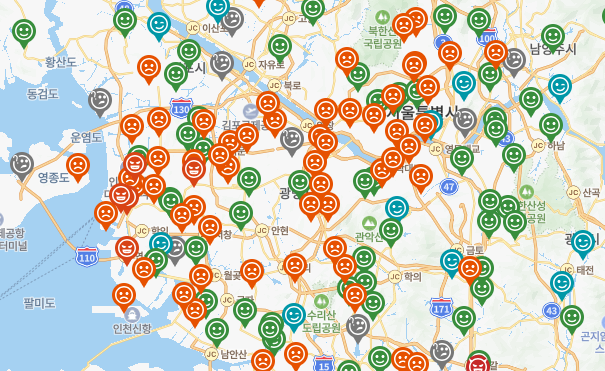
This is the most popular app in Korea due to its intuitive, color-coded interface. Instead of complex numbers, it uses a character’s facial expression and 8 distinct levels (from "Best" to "Worst").
- Blue/Grinning: Perfect. Go for a run.
- Green/Smiling: Normal. Good for outdoor activities.
- Yellow/Neutral: Moderate. Sensitive groups should be careful.
- Red/Frowning: Bad. Wear a KF94 mask.
- Black/Gas Mask: Very Bad/Awful. Stay indoors if possible.
B. AirVisual (IQAir)
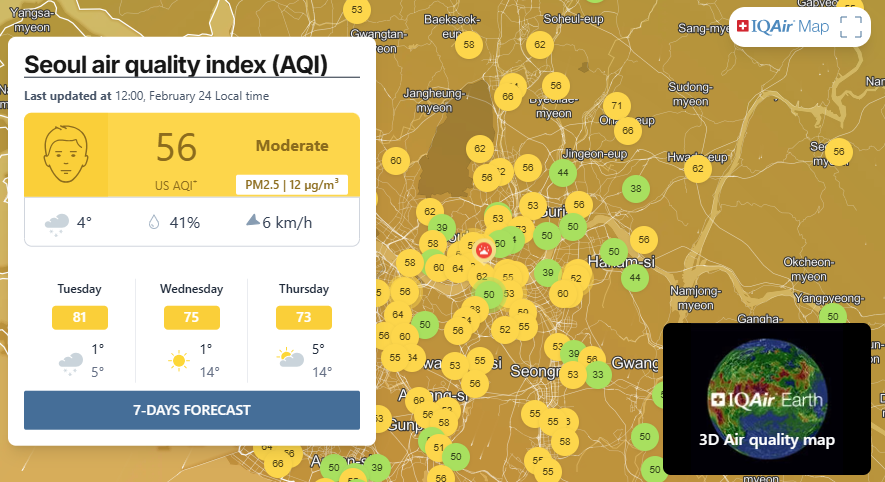
For expats who prefer international standards (US AQI), AirVisual is excellent. It provides 3D maps and historical data, which is great for seeing where the dust clouds are moving from.
4. Indoor Air Quality: Why Your Windows Stay Shut
When the dust levels hit the "Bad" (나쁨) or "Very Bad" (매우 나쁨) categories, your apartment's indoor air quality can quickly mirror the outside. Many expats make the mistake of leaving windows cracked for "fresh air," but during Yellow Dust season, that "fresh" air is carrying heavy metals and fine silica.
In Korea, we practice Hwan-gi (환기)—ventilation—differently during these months. Instead of long-term opening, we do "flash ventilation": open windows wide for just 3–5 minutes when the dust levels dip slightly, then close them and let your air purifier do the heavy lifting.
5. The "Air Purifier" Rental Hack
If you're staying in Korea for more than a year, buying a high-end air purifier (Gong-gi-cheong-jeong-gi) can be expensive. Brands like **LG PuriCare** or **Samsung BlueSky** can cost upwards of 500,000 to 1,000,000 KRW.
This is where the famous Korean Rental System comes in. Companies like Coway, SK Magic, and Cuckoo offer monthly plans that are perfect for expats:
- Low Upfront Cost: Pay between 20,000 to 40,000 KRW per month.
- Regular Maintenance: A "Cody" (service lady/man) visits every 2–4 months to deep-clean the machine and replace filters. This is vital because dirty filters actually circulate bacteria.
- Free Filter Upgrades: As new filter technology (like HEPA 13) comes out, rental companies often upgrade your unit.
| Brand | Estimated Monthly Fee | Pros |
|---|---|---|
| Coway | 32,000 KRW+ | Industry leader, best service network. |
| LG PuriCare | 40,000 KRW+ | 360-degree filtration, very stylish. |
| Winix | (Purchase only) | Best "Budget" option for outright purchase (approx. 250k KRW). |
6. Post-Exposure Care: The "Samgyeopsal" Myth?
There is an old Korean urban legend that eating **Samgyeopsal** (pork belly) helps "wash away" the dust in your throat because of the fat. While scientifically debunked (the dust goes to your lungs, the pork goes to your stomach!), the tradition persists.
The real local advice? **Hydration and Hygiene.** When you return home on a high-dust day:
- Wash your hands and face immediately.
- Use a saline nasal spray (available at any pharmacy/Yak-guk) to clear your nasal passages.
- Drink plenty of water to keep your throat moist, which helps your body’s natural filtration system (cilia) work better.
Final Thoughts from Michael
Yellow Dust season can feel claustrophobic, but don't let it ruin your spring in Korea. With a pack of KF94 masks from the convenience store and the MiseMise app on your home screen, you're already ahead of the game. Watch for the "Clear Sky" days—they are incredibly beautiful once the wind blows the dust away!
© 2026 Information of Korea. All rights reserved.


